What Is the Galleria Borbonica?
Not sure which route to book?The tunnel's public tours run on Fridays, weekends and holidays only, and every visit is guided and booked in advance. The standard route is what most people take; the Via delle Memorie option starts under Palazzo Serra di Cassano instead. The booking cancels free up to 24 hours ahead.
Compare the routesWhy a king wanted a tunnel
The uprisings of 1848 had shown Ferdinand II how exposed his palace was. On 19 February 1853 he signed a decree giving the architect Errico Alvino the job of building an underground road under Monte Echia. By the association’s own history, it was to be a fast military route between the Royal Palace and the barracks on what was then Via della Pace, today Via Domenico Morelli, near Piazza Vittoria, and an escape route for the royals if the crowds came again. Italian Wikipedia adds that it would have given the family a quick way to the sea.
Dug by hand, 1853 to 1855
Work started in April 1853 and was done entirely by hand. The gallery was cut 4 m wide and 3 m high, narrowing to about 1 by 2 m in the pedestrian sections, for a length of 431 m. The diggers kept running into what earlier Neapolitans had left in the hill: branches of a 17th-century aqueduct, old cisterns and pockets of loose volcanic deposit. The association calls that aqueduct the “acquedotto della Bolla”; Italian Wikipedia names it as the Carmignano aqueduct, built in 1627–29. Where a cistern was still in use, Alvino built bridges over it so the water supply was not cut, and those bridges are what you walk across today.
Finished, or not?
The sources do not agree, and I would rather tell you that than pick one. The association says the tunnel was completed in May 1855 and that Ferdinand II made the inaugural visit on 25 May, after which it was open to the public for three days. Italian Wikipedia says the work was done by 1855 but the eastern section was left incomplete because of the ground. English Wikipedia says construction stopped when the Bourbon dynasty fell, two years after it began, which cannot be right: the kingdom fell in 1860–61. What everyone agrees on is simpler. It was inaugurated in 1855 and never used for the purpose it was dug for.
The shelter, 1939 to 1945
During the Second World War the tunnel and the cisterns around it became an air-raid shelter for between 5,000 and 10,000 Neapolitans, by the association’s figure. Engineers put in electricity, a spiral staircase and toilets; Italian Wikipedia adds bunks and kitchen things. The people who slept here wrote on the walls, and those names, dates and drawings are still there. Lucia, one of the GetYourGuide reviewers, wrote that her guide “managed to make us empathize with the situation experienced in those years”, and that is the part of the visit that stays with people.
You will also read that the tunnel served as a military hospital. A few secondary sources say so. The association’s own history does not, and I would not repeat it as fact.
The pound, 1945 to 1970
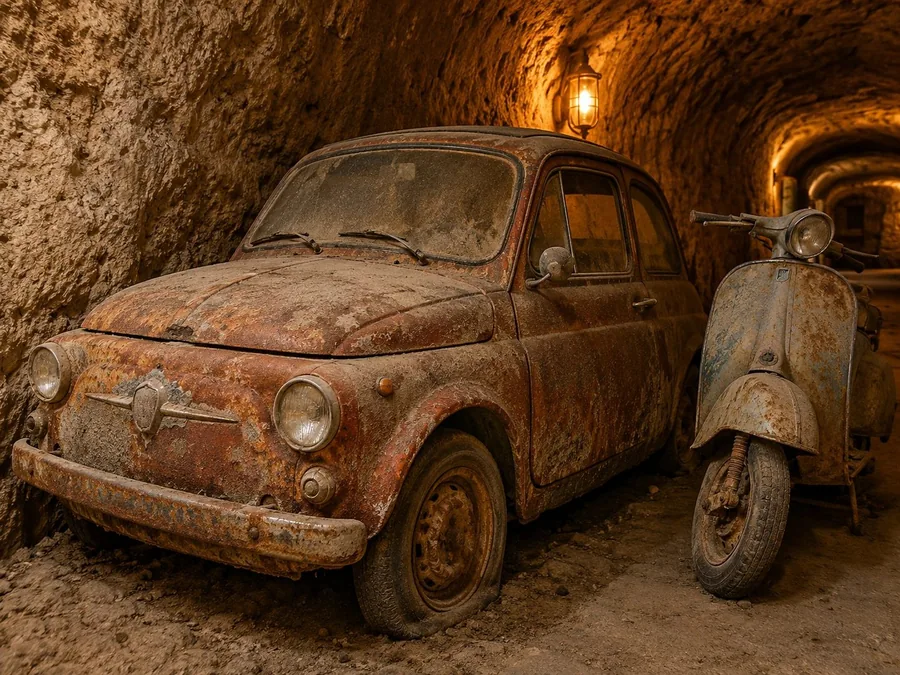
After the war the city used the tunnel as its judicial deposit, the place where seized and abandoned things were stored. The association gives the dates as 1945 to 1970; Italian Wikipedia says it was used until the 1980s, and another source says the 1960s. Into it went rubble from the bombing, cars, motorcycles, scooters and statues of several periods, and they are still where they were left. Among them is the funerary monument of Aurelio Padovani, made in 1934 and found in March 2010, according to Italian Wikipedia. The association describes Padovani as a Bersaglieri captain of the First World War. He was also, later, a leader of Neapolitan fascism, which the association’s page does not mention.
Rediscovery, 2005 to 2010
The geologists Gianluca Minin and Enzo De Luzio began looking into the tunnel around 2005. In 2007, by the association’s account, they found the walled-up 17th-century access used by the “pozzari”, the men who maintained the wells and cisterns. Volunteers cleared the debris, and the tunnel opened to the public in October 2010, on 29 October according to Italian Wikipedia. It is run by the Associazione Culturale Borbonica Sotterranea, which also uses the gallery for concerts.
Via delle Memorie, 2016
In 2013 Minin and De Luzio dug out a 17th-century cistern to reach the wartime shelter under Palazzo Serra di Cassano on Via Monte di Dio. That became the Via delle Memorie route, which opened on 30 January 2016. The four routes that exist now are compared on the four routes.
What people get wrong
- “It is part of Napoli Sotterranea.” No. Napoli Sotterranea is at Piazza San Gaetano in the historic centre, and it is Greek-Roman. Different site, different operator; see Bourbon Tunnel or Napoli Sotterranea.
- “Built in 1853.” 1853 is the decree and the start of the digging. It was inaugurated in 1855.
- “Built by the Spanish.” Commissioned by Ferdinand II of Bourbon and designed by Alvino. The Spanish-era work is the 17th-century aqueduct it cuts through.
- “After the riots of 1948.” A typo in one guide: 1848.
- “A shelter from 1936.” Italy was not at war in 1936. The association says 1939 to 1945.
- “Opened in 2005” or “2007”. Those are the start of the work and the find. The public opening was 2010.
- “Entrance at Via Morelli 40.” 40 is the car park’s address. The tunnel entrance is number 61.
What the Standard route shows you of all this, stop by stop, is in the complete guide.
Frequently asked questions
What is the Galleria Borbonica in Naples?
A 431-metre tunnel under Monte Echia, dug from 1853 for Ferdinand II of Bourbon as a military route and royal escape route, inaugurated in 1855. It was later a WWII air-raid shelter and a city pound, and opened to visitors in October 2010.
Who built the Bourbon Tunnel?
Ferdinand II of Bourbon ordered it by decree on 19 February 1853, and the architect Errico Alvino designed it. The digging, from April 1853, was done by hand.
Why are there old cars in the Bourbon Tunnel?
After the war the tunnel was the city’s judicial deposit, from 1945 to 1970 by the association’s dates. Seized and abandoned cars, motorcycles and scooters were stored there and never taken out.
How do I get to the Galleria Borbonica?
The main entrance is Vico del Grottone 4, about 100 m from Piazza del Plebiscito. The metro, funicular and walking routes are on getting there.